Sodium hypochlorite (NaOCl), the active agent in common bleach, is ubiquitous across industries - from food processing, healthcare to paper and textile manufacturing. Recognised primarily for its disinfectant, sanitising, and bleaching capabilities, its molecular mechanisms and industrial relevance are rooted in well-characterised oxidative chemistry. This review explores the chemical basis, antimicrobial mechanisms, industrial applications, safety implications, and emerging research on sodium hypochlorite - highlighting both its benefits and potential risks.
What Is Sodium Hypochlorite?
Sodium hypochlorite is an inorganic compound with the formula NaOCl. In its pure form, it is a pale greenish-yellow solid, but it is most often encountered as an aqueous solution. Commercial bleach typically contains 5–10% sodium hypochlorite by weight, while industrial solutions may be more concentrated.
Upon dissolution in water, sodium hypochlorite establishes an equilibrium between hypochlorous acid (HOCl) and hypochlorite ions (OCl⁻). HOCl is more prevalent and effective at near-neutral pH (6.0–7.5), while OCl⁻ dominates under alkaline conditions but is less antimicrobial. Both agents act as potent oxidants, targeting critical microbial structures and pathways.
Both HOCI and OCl⁻ are strong oxidants capable of:
- Protein and DNA oxidation: Disruption of cellular proteins, nucleic acids, and lipids through oxidation causes irreversible damage and cell death.
- Chloramine formation: HOCl reacts with amine groups, generating chloramines that impair microbial enzyme activity.
- Enzyme inactivation: Oxidation of thiol groups leads to irreversible loss of essential bacterial enzymatic functions.
- Saponification reactions: Lipid degradation in cell membranes contributes to structural breakdown and facilitates cleaning action.
Industrial Applications: From Food Plants to Clinical Applications
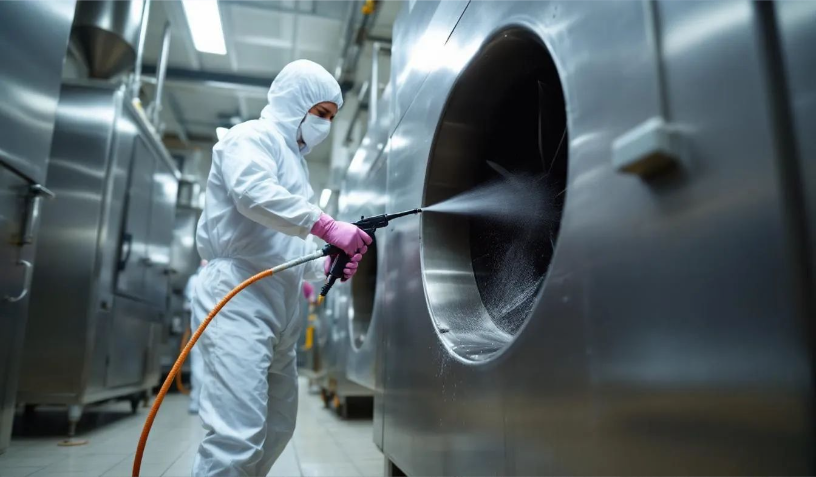
Food Plant Sanitation & Surface Disinfection
Sodium hypochlorite solutions (typically 0.01–0.5%) are extensively used in food processing environments to sanitise surfaces, equipment, and contact zones. Its low cost, ease of availability, and rapid broad-spectrum antimicrobial efficacy make it a mainstay in production-line hygiene. A comparative study reveals it outperforms quaternary ammonium compounds in disrupting resilient biofilms formed by Staphylococcus aureus and Pseudomonas aeruginosa.
Textile & Paper Bleaching
The textile and pulp industries leverage sodium hypochlorite’s strong oxidising property for bleaching cotton, linen, and pulp. Its strong bleaching action results from its ability to break down coloured compounds in fibres and pulps, delivering a high level of whiteness and brightness to finished materials
However, its use requires precise control and attention to safety, as it can damage fibres, equipment and pose environmental risks if misused. Today, while other processes are often preferred for environmental and material strength reasons, sodium hypochlorite remains a vital option for certain bleaching applications, especially where rapid and strong whitening is desired.
Endodontics & Clinical Applications
A documented case highlights sodium hypochlorite’s potential for harm when improperly applied. A 42-year-old patient undergoing routine root canal therapy received 12cc of 3% sodium hypochlorite over an hour. Shortly after, the patient experienced acute pain and swelling, progressing to airway obstruction that necessitated mechanical ventilation. Though she recovered without permanent damage, the event underscores the need for controlled delivery and vigilant monitoring when using sodium hypochlorite in clinical settings.
Limitations & Biological Implications
Antimicrobial Resistance Risk
Repeated exposure to sub minimal inhibitory concentrations (sub-MIC) of sodium hypochlorite may induce cross-resistance in Gram-negative bacteria like Klebsiella pneumoniae and Pseudomonas aeruginosa. Elevated expression of Resistance-Nodulation-Division (RND) efflux pumps has been shown to raise resistance to antibiotics such as imipenem after sodium hypochlorite exposure.
By-Product Formation
While effective, sodium hypochlorite can form chlorinated organic compounds (e.g. chloroform) during storage or in presence of organics—some of which may pose health concerns if not properly managed.
Surface & Material Compatibility
Its strong oxidising nature means sodium hypochlorite can be corrosive to metals or degrade organic surfaces if used undiluted or inconsistently. Organic residues must be cleaned prior to disinfection for maximum effectiveness.
Summary Table: Sodium Hypochlorite in Industrial Applications & Potential Risk
| Application | Function & Concentration | Evidence & Notes |
|---|---|---|
| Food plant sanitation | 0.01–0.5% to disinfect surfaces and equipment | More effective than quats on resistant biofilms (S. aureus, P. aeruginosa) |
| Root canal irrigation | 1–5% used to disinfect and dissolve tissue | Achieves rapid microbial kill; tissue dissolution as side benefit |
| Textile/paper bleaching | Higher-process concentrations for lignin removal | Efficient, industry-preferred bleaching agent. |
| Sub-lethal exposure risk | Repeated low dose exposure may induce microbial resistance | RND efflux pump overexpression leads to antibiotic cross resistance. |
| Potential by-products | Possible chlorinated organics if improperly used | Formed during storage or contact with organics; requires management. |
Innovations and Future Directions

Ongoing research continues to refine the use of sodium hypochlorite. Improved on-site electrochemical generation reduces transport hazards; smart dosing technologies ensure precise, efficient disinfection; and studies into greener, less reactive alternatives signal a future as mindful as it is hygienic.
Recent experiments also highlight sodium hypochlorite’s ongoing value against antibiotic-resistant pathogens and its use in emergency outbreak settings - a testament to how science, when paired with vigilance, remains a partner in resilience.
Sodium Hypochlorite - Scientific Rigour Meets Industrial Reliability

From industrial kitchens to clinical applications, sodium hypochlorite serves as an important and effective disinfectant and bleaching agent. Its mechanism of action, rooted in oxidation, disrupts microbial life at a molecular level. Though concerns like resistance and by-products demand careful management, its wide-spectrum efficacy, affordability, and proven performance makes sodium hypochlorite a reliable chemical agent in various applications. Ongoing research and clinical case analyses reinforce the necessity of informed handling protocols and precise application strategies to maximise efficacy while mitigating associated risks.
About Masda Chemical
Masda Chemical is a well-established company headquartered in Singapore. It operates primarily as an importer, exporter, and stockist of food ingredients and industrial chemicals. Representing a group of manufacturers and trading organisations known for their high-quality products, the company caters to diverse, specialised needs across multiple industries in the Asia-Pacific region. Its extensive network includes sales offices in China, Indonesia, Malaysia, Thailand, and Vietnam, enabling efficient service and regional reach.