
What Makes an Acid “Strong”?

To classify an acid, we examine how it behaves in water. Based on this behaviour, acids are broadly categorised as either strong or weak. An acid's strength is quantified by its ability to dissociate in water, releasing protons (H⁺) and forming its conjugate base. In chemistry, this is measured by the acid dissociation constant (Kₐ), which measures how completely it releases H⁺ in water. The smaller the Kₐ, the weaker the acid. Kₐ is often expressed in its logarithmic form, pKₐ, to facilitate comparison across different acids.
Acetic acid’s numbers
Kₐ ≈ 1.75 × 10⁻⁵ (pKₐ ≈ 4.76) at 25 °C.
Other tabulated Ka sources (e.g., URI, ThoughtCo) align: 1.8 × 10⁻⁵, pKₐ ≈ 4.7.
The lower the pKₐ (or the higher the Kₐ), the stronger the acid. For example, strong mineral acids like hydrochloric acid (HCl) has a pKₐ around –6 (Kₐ ≈ 10⁶), showing complete dissociation; by contrast, acetic acid’s pKₐ of 4.76 means it only dissociates to a small degree.
Molecular Insight: Why It’s a Weak Acid
The acidity of acetic acid arises from the –COOH group, where a hydrogen proton dissociates, leaving the conjugate base (acetate, CH₃COO–). The delocalisation of negative charge across two oxygen molecules stabilises the base, at 1M concentration, only ~0.4% of acetic acid molecules dissociate, underscoring its weak acidic nature. The majority remain undissociated, existing as CH₃COOH. This partial ionisation is the hallmark of a weak acid.
Chemical Behaviour Beyond the Classroom
Beyond its dissociation properties, acetic acid exhibits distinct chemical behaviours that influence its reactivity and industrial relevance. Its chemical profile is influenced by various physical and structural factors:- Intermolecular Forces: In pure form and some solvents, acetic acid molecules form “dimers” via hydrogen bonds, affecting their boiling point and other properties.
- Reactions: It participates in classic acid-base reactions (with carbonates, bases, and metals), forms esters, amides, and anhydrides, and decomposes at high temperatures.
- Corrosivity: While less aggressive than mineral acids, concentrated acetic acid is still corrosive, particularly to some metals and organic tissue.
Applications in Food Safety and Industry

In its diluted form, acetic acid is widely used in food preservation and as a flavouring agent. Its antimicrobial properties make it valuable for pickling and preventing spoilage in food.
| Application | Description | Examples |
|---|---|---|
| Food preservative | Acetic acid is widely valued for its strong antimicrobial properties. By lowering pH and creating an inhospitable environment for bacteria, moulds, and yeasts, acetic acid extends the shelf life of a wide array of foods. |
|
| pH regulator & flavour enhancer | Acetic acid is a key acidulant in food manufacturing. It helps control the pH of food to ensure safety, consistent flavour and texture in sauces, dressings and canned foods. |
|
| Vinegar wash for produce | Acetic acid - most commonly encountered as household vinegar - is a popular, affordable, and effective option for cleaning fruits and vegetables at home. 1.9% solution reduces E. coli by ~5 log CFU/g; 0.5–1% reduces Listeria/Yersinia by 1–3 log CFU/g These reductions confirm acetic acid’s effectiveness as a natural decontaminant. |
|
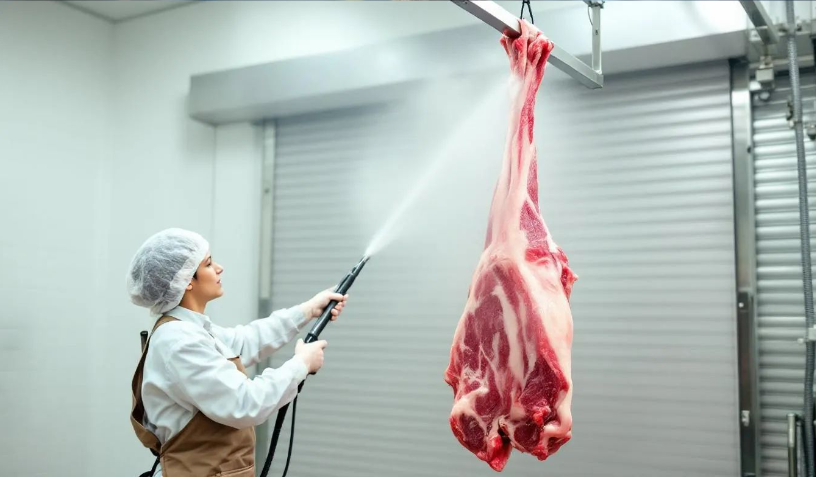
| Meat carcass decontamination | Widely used as spray in the meat industry to decontaminate meat carcasses, particularly in beef and other red meat processing. Its primary role is to reduce microbial contamination on carcass surfaces during slaughter and processing, thereby improving food safety and extending shelf life. |
|
| Water-in-oil emulsions | Acetic acid, via its esters with mono and diglycerides, is essential in producing stable water-in-oil emulsions in foods by acting as a specialised emulsifier. These compounds facilitate consistent product quality, desired texture, and contribute to microbial control. |
|
Effective, Safe & Industry-Preferred
Acetic acid’s status as a “weak” acid brings advantages in safety and environmental compliance:
| Factor | Explanation |
|---|---|
| Effectiveness | Potent antimicrobial and extends shelf life by inhibiting spoilage organisms. |
| Safety | Non-corrosive at low concentrations. It is also a natural and familiar household food and cleaning ingredient, such as vinegar. |
| Versatility | Preservative, flavour enhancer, acidulant, leavening agent and emulsifier. |
| Cost-Effectiveness | Affordable, widely available and reduces the need for multiple additives. |
| Consumer Acceptance | Aligns with consumer demand for clean-label and natural preservatives. |
| Regulatory Compliance | Approved as GRAS (Generally Recognized as Safe) by the US FDA for use in food |
| Sustainability | Biodegradable and aligns with natural product trends. Many food manufacturing plants now integrate acetic acid-based sanitation protocols to replace harsher chemicals like peracetic acid and chlorine, achieving comparable microbial control with better safety margins. |
Conclusion: Weak Acid But Strong in Value
Acetic acid’s classification as a weak acid (low degree of dissociation in water and a moderately high pKₐ) is based purely on ionisation metrics, not effectiveness. It’s a classic example in chemistry: mild in everyday concentrations yet corrosive and dangerous when concentrated.
Its weak acid status underpins its wide use in food, medicine, and other industrial applications. However, its corrosivity at higher concentrations reminds us that ‘weak’ refers strictly to dissociation, not safety. As its scientific study continues, acetic acid remains both a simple household ingredient and an indispensable chemical ingredient in modern manufacturing.
About Masda Chemical
Masda Chemical is a well-established company headquartered in Singapore. It operates primarily as an importer, exporter, and stockist of food ingredients and industrial chemicals. Representing a group of manufacturers and trading organisations known for their high-quality products, the company caters to diverse, specialised needs across multiple industries in the Asia-Pacific region. Its extensive network includes sales offices in China, Indonesia, Malaysia, Thailand, and Vietnam, enabling efficient service and regional reach.